
There’s a reason so many Greece itineraries look the same: two or three nights in Athens, a ferry, an island, repeat. It’s not that you don’t know better. It’s that building something more layered takes knowing a portfolio well enough to place each property against a specific kind of traveler, and that’s harder to do than it sounds.
Grecotel makes that easier than most groups do, mostly because its properties don’t resemble one another much. The same family-run group operates a 46-room mansion steps from the Acropolis and a beachfront resort with exclusive guest access to a recreated village a short drive from Corfu’s coast.
Matching the right property to the right client only solves half of it. Getting from one region to the next without the trip feeling stitched together is the other half, and that’s where UJV Europe’s destination specialists come in: in-travel support, ferry and transfer coordination, and access to properties like Grecotel that aren’t always easy to book directly.
See the full destinations overview for UJV’s broader European footprint.
Key Takeaways
- • Grecotel is Greece’s largest luxury hotel group, family-run, founded in Crete, with 40 properties across 15 prime locations across Greece.
- • Six properties across five regions anchor this guide: THE DOLLI at Acropolis (Athens), Cape Sounio and The Roc Club (Athens Riviera), Corfu Imperial (Corfu), Amirandes (Crete), and Mykonos Blu (Mykonos).
- • Cape Sounio made Tatler’s 101 Best Hotels in the World for 2026; THE DOLLI was voted Greece’s #1 hotel by Condé Nast Traveller readers.
- • Athens, Corfu, and Crete are built for longer stays; Mykonos works best as either a standalone trip or a high-energy finale to a longer itinerary.
The Family-Run Group Behind Six Very Different Hotels
The Daskalantonakis family founded Grecotel out of Rethymno, Crete, opening their first hotel there in 1975 and growing the business across three generations since. The group is now part of the N. Daskalantonakis Group, and has become the largest luxury hotel collection in the country with 40 properties on the mainland and islands combined.
Size alone wouldn’t matter much if the properties blurred together, but they don’t. A guest at Cape Sounio wakes up looking at a 2,500-year-old temple. At Amirandes, they eat dinner next to an original Picasso ceramics collection. A guest at Corfu Imperial gets exclusive access to a recreated Corfiot village, called Danilia Village, which is a short drive from the resort.
That level of specificity is exactly what makes a portfolio like this worth learning property by property instead of treating “Grecotel” as a single brand decision. The six below cover five regions of Greece, and each one solves for a different kind of trip.
How to Match a Grecotel Property to the Right Client
The region decides the shape of the trip. The property decides who it’s actually for.
A quick way to think through it:
- • Wants Athens for the history and the food: THE DOLLI at Acropolis.
- • Wants Greece to feel mythological, not just scenic: Cape Sounio.
- • Wants Riviera energy without a full week of resort time: The Roc Club.
- • Traveling as a family or multigenerational group: Corfu Imperial.
- • Design-forward or food-forward, and staying longer: Amirandes.
- • Wants to be in the middle of the Mykonos scene: Mykonos Blu.
None of this is about which property is “best.” It’s about which one actually fits the client asking. That match is also where a lot of the value of working with a destination specialist shows up: sequencing more than one region into a single trip, so a client moving from Athens to Corfu or Crete doesn’t feel like they’re stitching together three separate vacations.
Athens: More Than a Stop Before the Islands
Athens gets treated as a stopover more often than it deserves. History and food alone justify a longer stay here, and the layered contrast between an ancient city and a genuinely modern one is easier to feel over three nights than one.
The DOLLI® at Acropolis, A Hotel to Live®
Location: Mitropoleos 49, Athens, Greece.
Good fit for: couples, culture-first travelers, and clients who want to walk to the Acropolis without giving up five-star service.
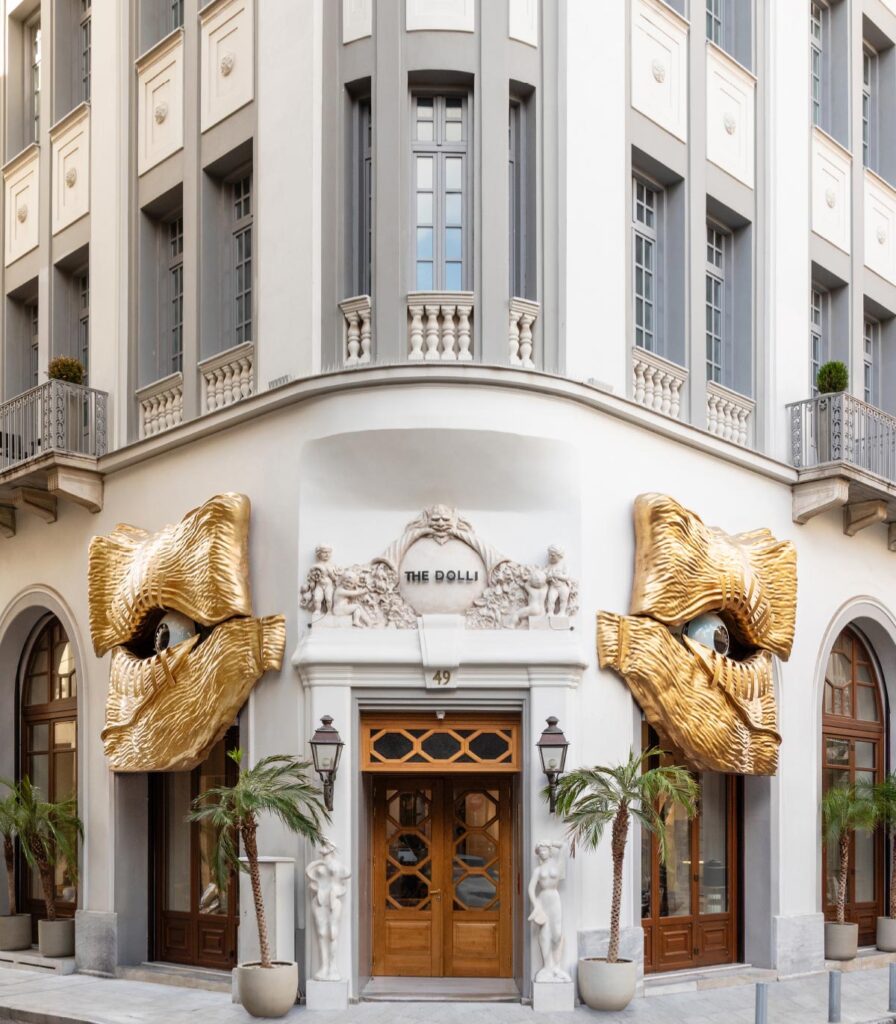
The building housing THE DOLLI has a longer history than the hotel itself. Andreas Kriezis, the architect who designed it, later went on to convert Athens’s Royal Palace into what’s now the Hellenic Parliament building, and the mansion he built on Mitropoleos Street eventually became THE DOLLI: 46 rooms, pieds-à-terre, and private apartments, all within walking distance of Plaka, Monastiraki, and Syntagma Square.
When the property was restored, it won an international architecture prize, becoming the first Greek hotel to receive one. Walking the halls today, that restoration shows up as much in the art as in the architecture: pieces by Picasso, Jean Cocteau, and François-Xavier and Claude Lalanne sit in the lobby, at Le Salon, and inside Le Bar Secret. None of it feels like a museum wing bolted onto a hotel. It reads more like a private collection someone happens to also let you sleep in.
The Parthenon shows up most dramatically at night. DOLLI·S, the rooftop restaurant, sits beside an infinity pool reserved for guests, with a direct line of sight to the Acropolis and nothing in the way. Condé Nast Traveller’s readers voted THE DOLLI the #1 hotel in Greece, and it’s since turned up in Vogue, the Financial Times, Travel + Leisure’s World’s Best Awards, and the Michelin Guide.
Advisors selling THE DOLLI are usually solving for a client who wants Athens to feel like a destination in its own right, not a launching pad. It suits a couple more naturally than a family, given the scale, and pairs well with almost anything that follows since it sits close enough to walk most of central Athens.
Athens Riviera: Real Range South of the City
South of the city, the coast offers something most travelers never see, because most itineraries move straight from Athens to the airport or the port without stopping.
What’s there instead: thermal lakes, marinas, and one of the most mythologically loaded stretches of coastline in the country.
Cape Sounio, A Resort to Live®
Location: Sounio, Athens Riviera, Greece.
Good fit for: couples, milestone trips, and multigenerational groups wanting a resort that feels rooted in its setting rather than interchangeable.
The Temple of Poseidon at Cape Sounio has stood since the 5th century BC, and Grecotel built its resort into the landscape below it rather than beside it, arranging bungalows, suites, and villas amphitheater-style so most rooms face the temple directly.
Legend holds that King Aegeus leapt from these cliffs into the sea in grief, believing his son Theseus had been killed by the Minotaur, and that’s how the Aegean Sea got its name. Cape Sounio made Tatler’s 101 Best Hotels in the World for 2026, and its full moons rising behind the temple have been covered by outlets ranging from the New York Times to NASA.
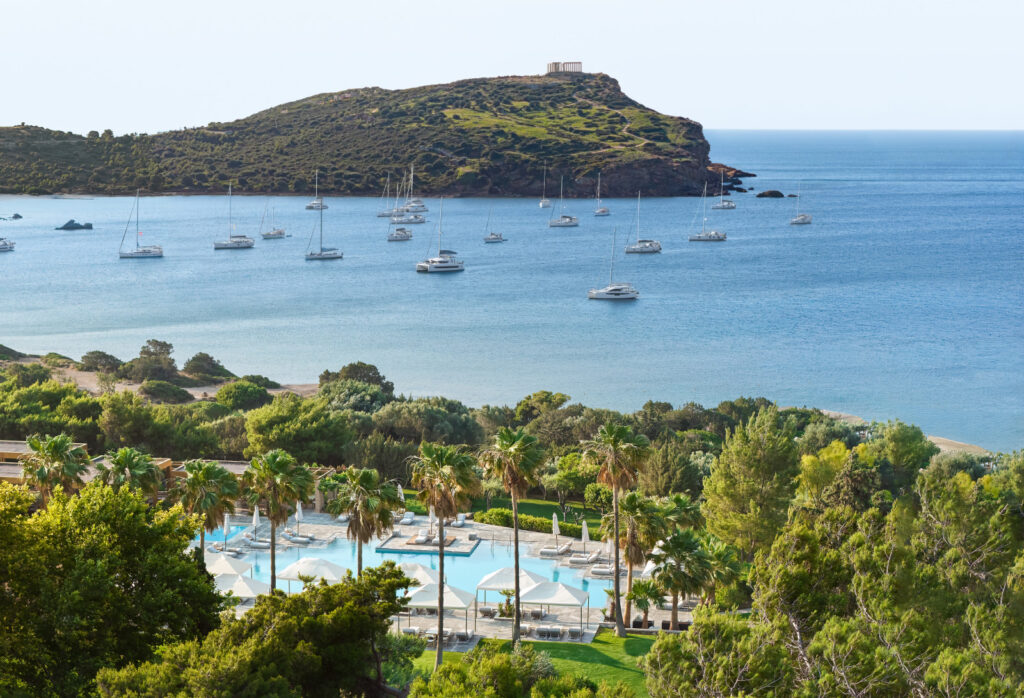
The resort sits 40 minutes from Athens International Airport, with Lavrio port 10 minutes away, close enough that pairing a Cape Sounio stay with an island afterward barely adds to a transfer.
Eight restaurants and bars are spread across three private beaches and a stretch of pine forest, including the all-day Aegean Grill and a newer poolside spot built around wood-fired ovens. A recently added Holistic Wellness Program, developed by Gwyneth Paltrow’s go-to healer, Vicky Vlachonis, gives the spa side of the property a genuine point of difference rather than a standard treatment menu.
Families get real value here specifically: children 12 and under stay and eat free, with the Grecoland kids’ club and a separate family pool running alongside it. For a larger group, the Estate on the Hill, a private 350-square-meter complex with three pools of its own, a private garden, and room for 10 guests, is the kind of booking that turns a family trip into an event.
The Roc Club, A Hotel to Live®
Location: Vouliagmeni, Athens Riviera, Greece
Good fit for: repeat Greece travelers and couples wanting something quieter and more residential, front-loaded at the start of a longer trip.
Vouliagmeni doesn’t get much attention outside Greece, which is part of its appeal. The Roc Club sits right on the lake that gives the area its name, a body of water fed by underground thermal springs and framed by caves that have drawn people to swim there for centuries.
The hotel itself is intentionally small, with just 34 rooms and suites, most overlooking the Vouliagmeni peninsula and marina, and a rooftop bar that catches the same view after dark.
The property’s most distinctive feature is architectural rather than culinary or historical: the Roc Pool is carved directly into the rock beside the lake, not built on top of a poured foundation the way most hotel pools are. It’s about 30 minutes from Athens airport, close enough to the new Astir Marina and Vouliagmeni’s beach clubs that a guest never has to go far for either quiet or energy, depending on the day.
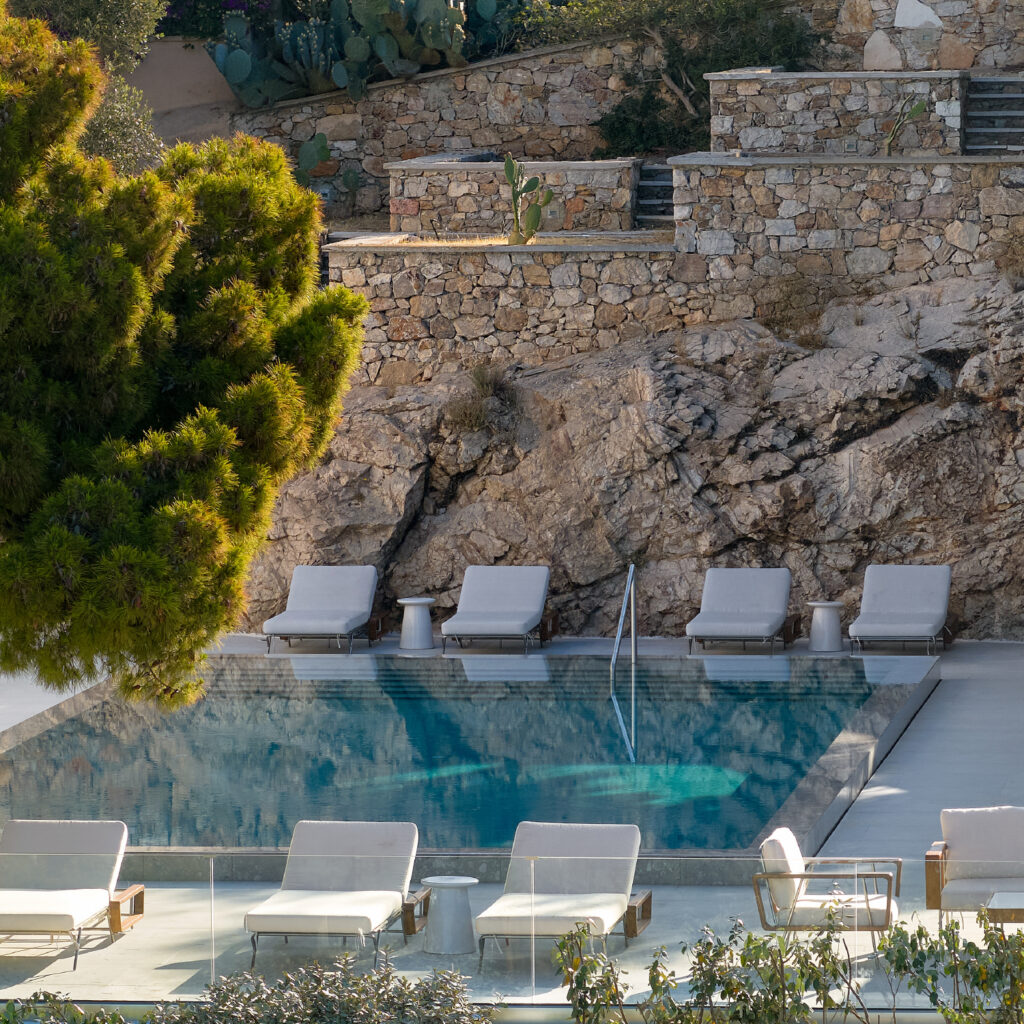
The Roc Club tends to work best as a first or last stop rather than the anchor of a trip. Advisors placing clients here are usually solving for someone who’s already spent a week or two in Greece before and wants a smaller, quieter Riviera stay rather than another full island week.
Corfu: A Slower, Greener Pace
Corfu doesn’t behave like the Cyclades. Centuries of Venetian rule left the island greener and more layered historically than the whitewashed islands most people picture when they think of Greece, and the pace on the ground reflects that. It’s a better match for families and multigenerational groups than for a client chasing nightlife.
Corfu Imperial, A Resort to Live®
Location: Kommeno Peninsula, Corfu, Greece.
Good fit for: families and multigenerational groups wanting space, culture, and a slower rhythm than the Cyclades circuit.
Corfu Imperial has its own peninsula, Kommeno, about 20 minutes from the island’s airport, with Blue Flag beaches on both sides and Ionian Sea views that stretch toward Corfu town. The single detail that separates it from most beach resorts is Danilia Village, a recreated traditional Corfiot village about 14 minutes from the resort, built around a Kafeneion café, a folklore museum, a working vineyard and olive mill, and an old-fashioned print shop.
Guided tours run exclusively for Corfu Imperial guests on Tuesdays and Fridays, with round-trip transfer and a treat at the “Kafeneion” included, and a separate evening Greek village dinner is available by reservation. The village also doubles as a private events venue and is part of the resort’s Dine Club Halfboard dining program.
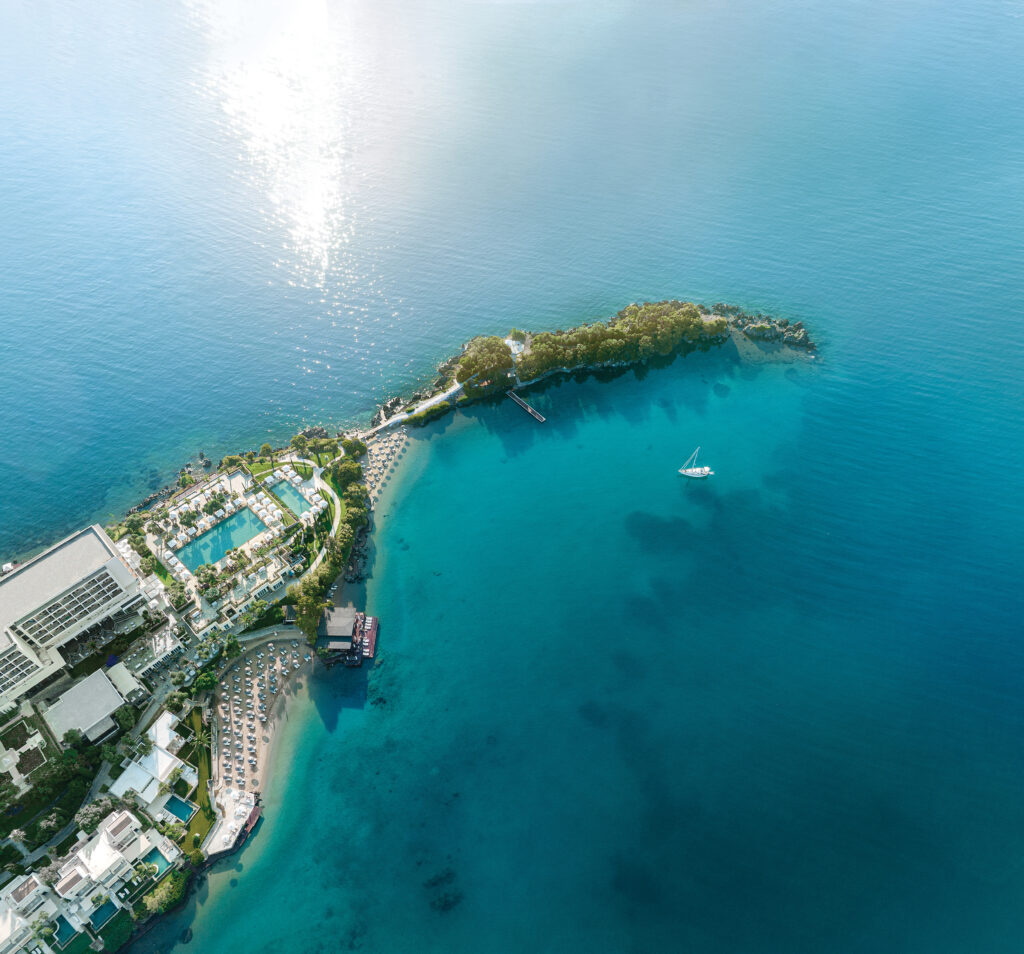
Dining beyond the village runs to nine restaurants and bars: Yali, a seafood restaurant built out over the water with views to Corfu town; Aristos, doing French; and a proper Trattoria, among others. The villa collection is built for scale in a way that’s genuinely hard to match elsewhere in the portfolio.
The Medusa Estate, a 411-square-meter residence on a hilltop, sleeps up to 12. The Two Villa Residence comes with a private beach and two pools between its eight guests. The Palazzo Imperiale sits on its own small peninsula inside the resort, private even by the standards of a private resort.
Crete: Enough Depth to Stand on Its Own
Crete carries a different weight than the rest of Greece. Minoan ruins, mountain villages, and a food culture distinct enough that Cretan cuisine gets discussed on its own terms rather than lumped in with “Greek food” generally, all of which reward a client who’s willing to stay more than a few nights.
Amirandes, A Resort to Live®
Location: Hersonissos, Crete, Greece.
Good fit for: design-minded and food-forward travelers, and longer Crete stays that want substance alongside scenery.
Amirandes sits on Crete’s north coast, roughly 20 minutes from Heraklion International Airport and 25 minutes from Heraklion town, close enough to the Palace of Knossos that a half-day trip there barely dents a stay. The resort’s architecture leans directly on Minoan design cues: whitewashed walls, wide arches, and pitharia, the oversized ceramic storage vessels that show up in archaeological sites across the island, worked into the grounds as design elements rather than museum pieces.
The property has 204 accommodations in total, spanning standard rooms and bungalows up through two- and three-bedroom duplex suites, seafront suites with heated pools and in-room gyms, and private villas with their own courtyards and infinity pools.
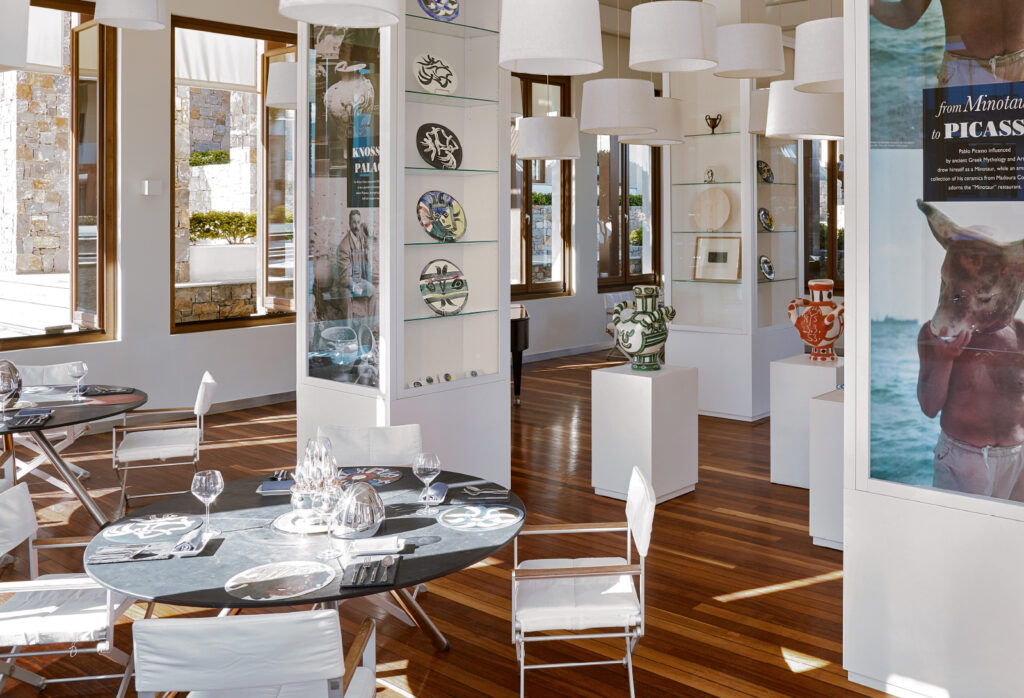
Dining is where Amirandes earns most of its reputation. Minotaur, the signature restaurant, is built around an original Pablo Picasso ceramics collection displayed throughout the dining room, a detail that gives the resort a genuine talking point beyond food quality alone. Xasteria, the Cretan restaurant, sources from Grecotel’s own Agreco Farm rather than a generic supply chain. Between those two and five more venues, the resort runs nine restaurants and bars in total.
A 960-square-meter Olympic-sized pool anchors the property, and 58 additional private pools are spread across the villas and suites, which gives Amirandes more private-pool inventory than almost anywhere else on this list.
Mykonos: It Sells Itself, But Only to the Right Traveler
Mykonos doesn’t need an introduction the way the other four regions do. Beach clubs, fashion, late nights, and Psarou at the height of summer are already the pitch for a specific kind of client, and that client usually already knows they want to go.
Mykonos Blu, A Resort to Live®
Location: Psarou, Mykonos, Greece.
Good fit for: a high-energy finale to a Greece itinerary, or a standalone stay for clients specifically chasing the Mykonos scene.
Mykonos Blu sits directly on Psarou Beach, close enough to Nammos Village’s boutiques and restaurants that a guest can walk to the center of the island’s social scene without a car. The resort went through a recent renovation, and its floating suites and villas now come with private pools set right on the waterfront, a detail its own private villas were recognized for in a recent Architectural Digest feature.
The BLU cave pool is the property’s signature: carved into the existing rock formation rather than poured as a standard structure, similar in spirit to what The Roc Club has done on the Riviera, just with an Aegean island backdrop instead of a lake.
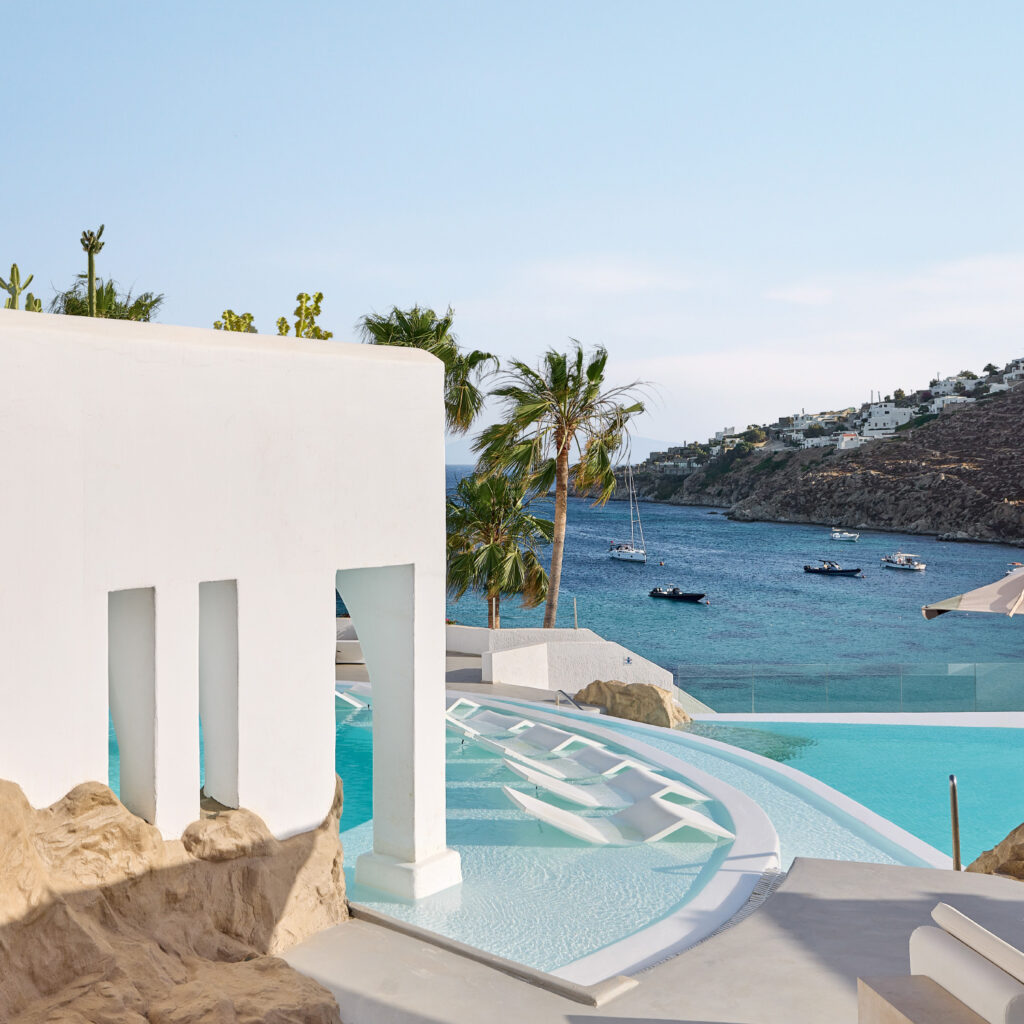
The dining varies from Mediterranean to Asian, served in settings scaled for conversation rather than volume. Mykonos Blu tends to close out an itinerary well: after a slower stretch in Athens, Corfu, or Crete, it gives a trip a final few nights of genuine energy, or it works entirely on its own for a client who’s specifically after the Mykonos scene and isn’t building a longer Greece trip around it.
Building a Grecotel Itinerary
Building a Grecotel itinerary is only half the job. Getting a client from a rooftop table in Athens to a private villa on Corfu, with every driver, guide, and ferry connection actually in place in between, is where a trip either holds together or starts to feel stitched-together.
That’s what UJV Europe is here to handle.
Our team of destination specialists works in-region, in the same hours as your clients they’re serving, rather than running logistics from a desk on the other side of the world. That means multi-property, multi-region itinerary design across all six Grecotel properties, ferry and ground transfer coordination between them, private guides for Athens, Corfu, Crete, and the Cyclades, and full handling of dining, spa, and celebration bookings at each stop.
What sets that support apart in practice: drivers, guides, and meeting points get reconfirmed proactively, before they’re ever needed, so a problem gets caught and solved locally instead of turning into a message waiting for someone to wake up to.
That same footing in the region is also what opens access to family-run and independent properties, Grecotel among them, that are harder to reach through a standard U.S.-based operator working off a vendor list.
For Greece specifically, that matters more than it would almost anywhere else, since a strong itinerary here usually crosses more than one region. Getting Athens to line up with a Riviera stay, timing Corfu or Crete against a Mykonos finale, and keeping the whole thing feeling like one trip instead of three separate vacations: that’s the part UJV Europe is built to carry, so you don’t have to carry it alone.
Whether you’re planning a first-time Greece itinerary or matching a returning client to the right Grecotel property, your UJV Europe Destination Specialist is ready to help build it.
Frequently Asked Questions
What is Grecotel?
Grecotel is a family-run hotel group founded by the Daskalantonakis family, who opened their first hotel in Rethymno, Crete, in 1975. It’s the largest luxury hotel operator in Greece, with 40 properties across the mainland and islands, spanning boutique city hotels to large beachfront resorts.
Which Grecotel property is closest to the Acropolis?
THE DOLLI at Acropolis is the closest, located on Mitropoleos Street within walking distance of the Acropolis, Plaka, Monastiraki, and Syntagma Square. It’s a 46-room boutique hotel with a rooftop restaurant that looks directly at the Parthenon.
Which Grecotel hotel is best for families?
Corfu Imperial and Cape Sounio both work well for families. Cape Sounio offers free stays and dining for kids up to 12, plus a dedicated family pool, while Corfu Imperial’s villa collection and exclusive access to nearby Danilia Village suit multigenerational groups wanting more space.
Does Grecotel have a property in Mykonos?
Yes. Mykonos Blu sits directly on Psarou Beach, one of the island’s most well-known stretches of sand, with floating suites and villas that include private pools on the waterfront.
What makes Amirandes in Crete stand out?
Amirandes is known for its Minoan-inspired architecture and its dining scene, including Minotaur, a restaurant set among an original Picasso ceramics collection. The resort has 204 accommodations and 58 private pools spread across its suites and villas.