
Seven thousand acres. The Dominican Republic gets bigger here.
La Romana sits on the country’s southeastern coast, between the Caribbean and the Chavón River. This is a different side of the Dominican Republic from the long resort corridors many clients know. The beach still matters, but it is only one part of the landscape.
Casa de Campo stretches across it, with 315 guest rooms and suites alone spread among the gardens and fairways. The scenery keeps shifting: near the coast, Pete Dye fairways meet pale coral rock and open Caribbean water; inland, palms and flowering gardens give way to polo fields, private villas, the marina, and Altos de Chavón above the river.
There is no single center. At most Caribbean resorts, the week stays close to one shoreline. Here, each part of the property gives the day somewhere different to go.
Teeth of the Dog may be the name clients recognize first, long considered the No. 1 course in the Caribbean, but golf only opens the conversation.
The First Drive
For somewhere this large, Casa de Campo is surprisingly easy to reach. La Romana International Airport is a short drive away. Punta Cana and Santo Domingo also work as gateways, with private transfers available from either direction.
The scale becomes clear beyond the entrance. Low, two-story guest buildings sit among palms, tropical gardens, and stretches of fairway. The lobby, main pool, Golf Pro Shop, and course starter are close by; after that, Casa de Campo opens in several directions.
A four-passenger golf cart waits outside every room, suite, and villa. The resort shuttle runs on an approximately 30-minute schedule, but most guests learn Casa de Campo from behind the wheel, with the map unfolded across someone’s lap and warm air moving through the open sides.
The first signs point toward Minitas Beach, the Racquet Center, the Equestrian Center, and the Shooting Center. The marina and Altos de Chavón sit beyond the main hotel area.
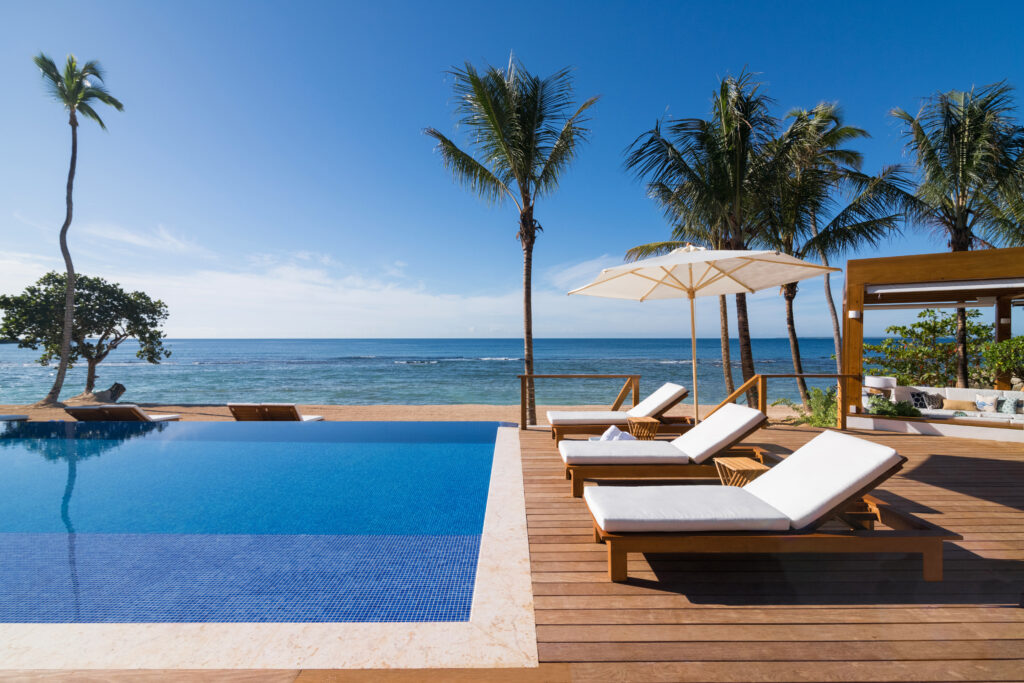
At first, everyone is simply trying to remember the turns. Then the place starts to reveal itself: the guest buildings disappear behind them, fairways stretch alongside the route, and flashes of Caribbean blue appear through the palms on the way to Minitas.
Keep going and the setting changes again. White boats fill the marina; in another direction, the climb toward Altos de Chavón brings the village’s honey-colored stone into sight.
Leave the first afternoon open for this drive. By dinner, the map is already folded away. Guests know how to reach the beach, where the courses begin, and how much time to allow when the evening takes them above the Chavón River.
Seven thousand acres no longer feels like a number. It feels like the week ahead.
Minitas in Blue
The Caribbean comes into view in pieces: palms first, then a flash of blue, then the whole shoreline.
Minitas Beach sits around eight minutes from the main hotel area by golf cart, far enough that the drive feels like going somewhere. At the end are Casa de Campo’s private beach, the family pool complex, water sports, and Minitas Beach Club & Restaurant, all gathered along the same stretch of coast.
This is the easiest first full day. Children move between the pool and the sand, or head off with the resort’s supervised Kids Programs, which run activities for every age group so parents get a stretch of the day to themselves too.
Couples take a table near the water and let lunch run late. The more active head out on the water; everyone else stays near the beach club and lets the morning slow down.
Because Casa de Campo is so large, Minitas should have a place in the itinerary. Leave it to chance and the beach can become somewhere guests keep meaning to reach.
Put it on day two and the week starts simply: they learn the route, spend the morning by the water, and still have the afternoon open.
By midafternoon, damp towels and beach bags go back into the cart. One group returns to the villa pool; another heads to the spa. The golfers may already be coming back from Teeth of the Dog.
The day starts with the Dominican Republic most clients came expecting. Then Casa de Campo shows them how much more there is.
The Room, the Suite, or the Villa
Where clients stay determines the center of their Casa de Campo experience.
The hotel rooms sit close to the lobby, main pool, and golf facilities. With one king bed or two doubles and space for up to four guests, they suit couples and smaller groups that want the main hotel area within easy reach. Connecting rooms keep families and friends close while giving everyone a door of their own.
The one- and two-bedroom suites add living and dining space, along with an extra half bathroom. They give clients room to gather while keeping the ease of a hotel stay.
Premier Suites add personal check-in, daily hors d’oeuvres, and a private lounge. For a smaller celebration, the three-bedroom Premier Presidential Suite keeps everyone together with more space to share.

Then there are the villas. The villa is already awake before everyone else.
Breakfast is being prepared inside, and coffee reaches the table first. Outside, the pool is still quiet; one cart waits with clubs secured to the back while another slowly fills with beach bags.
Casa de Campo’s villas range from three to 12 bedrooms, each with its own bathroom and air conditioning. Every one has shared living spaces, a private pool and patio, daily breakfast, and a full staff.
The golfers can leave early. Another part of the group stays by the pool, heads toward Minitas, or keeps the first few hours open. No one has to wait for 10 or 15 people to agree on one plan.
Later, everyone returns from a different part of Casa de Campo. Golf bags collect near the door. Damp towels appear beside the pool. Drinks are poured before dinner while the group compares days that looked nothing alike.
For multigenerational travel, reunions, friends traveling together, milestone birthdays, and larger celebrations, the villa becomes more than the accommodation. It gives the group a private center inside 7,000 acres: breakfast together, room to separate, and one place everyone comes back to.
Where the Fairway Meets the Caribbean
The first part of a golf morning is green. Clubs are loaded. The cart follows clipped fairways while palms cast long shadows across the grass.
Then the Caribbean appears beyond the coral rock.
Pete Dye carved Teeth of the Dog from this coastline more than 50 years ago. Its ocean holes became the image golfers carried home, with the water close enough to change the wind, the view, and the shot in front of them.
In 2026, Teeth of the Dog reopened following a restoration reported at roughly $15 million, led by Jerry Pate Design. Pate is not just a name attached to the project; he won the U.S. Open in 1976, and his history with this course runs back to 1974, when he played here on the winning American team at the World Amateur Team Championship.
The friendship he built with Pete Dye that week eventually made him the natural choice to restore Dye’s own design decades later.

All 18 greens were rebuilt, with their edges brought back to the exact dimensions Dye laid out originally, undoing the subtle drift that 50+ years of Caribbean weather works into any coastal course.
The entire course was re-grassed in Dynasty Paspalum, a grass suited specifically to seaside conditions, so fairways and greens should hold up firmer and play more consistently through the year.
Every bunker was rebuilt to Dye’s original flat-bottomed style with sharper faces, bringing back some of the bite the course was always known for. Drainage and irrigation were upgraded throughout, and new cart paths came with the work, so the round plays firmer underfoot and moving between holes feels as considered as the golf itself.
The course looks sharper; the coastline still does what it has always done: pull the eye away from the scorecard.
Returning golfers have a clear reason to play it again. First-time players arrive at a meaningful moment, with the design renewed and the ocean holes still carrying the legacy that made Casa de Campo one of the Caribbean’s defining golf destinations.
Tee times should be among the first details confirmed. Golf, however, is not the only morning worth planning. The Racquet Center has tennis, pickleball, and padel. The Equestrian Center hosts world-class polo tournaments, while the 250-acre Shooting Center holds more than 200 stations.
Come evening, eight restaurants and eight bars and lounges mean dinner never has to happen the same way twice. The Forbes Four-Star spa, the only one in the Dominican Republic to hold that distinction, gives the day a quieter direction.
Teeth of the Dog may bring the golfer. The rest of the day is what keeps everyone else.
The Marina and Altos de Chavón
Late afternoon belongs to another side of Casa de Campo.
At the marina, white boats line the water beside shops and restaurants. Some guests arrive after a fishing charter. Others come for a walk, a drink, or dinner before continuing farther across the property.
From there, the road climbs toward Altos de Chavón. The marina falls behind. The stone village comes into view above the Chavón River, warmer in the last light and entirely different from the beach morning that began the day.

Altos de Chavón deserves more than a quick stop before dinner. The village has its own shops and restaurants, along with a 5,000-seat amphitheater that has hosted Andrea Bocelli, Elton John, Gloria Estefan, Maroon 5, Sting, and other major performers.
Check the calendar before confirming the stay. A concert can become the evening the whole week is built around. Casa de Campo’s annual events can shape the dates too, from the Food & Wine Festival and its dinners under the stars to the Casa de Campo Open and Caribbean Pro-Am.
One afternoon can begin beside the boats at the marina, continue through the village, and end over dinner or beneath the lights of the amphitheater.
Guests start the day in swimsuits beside the Caribbean. By evening, they are walking through stone streets above the river.
The address never changed. Everything around them did.
How to Build the Week
Five to six nights give Casa de Campo enough room to feel complete. Anything shorter risks turning the stay into a list of places clients passed once.
Give Minitas an early place in the week, then build the more scheduled days around the experiences that matter most. Tee times, spa appointments, fishing charters, dining, and any plans tied to a birthday, anniversary, reunion, or larger celebration should be confirmed early.
With those pieces in place, there is still time for the marina, Altos de Chavón, another sport, and a final day left open for whatever clients want to repeat.
One day beyond Casa de Campo can add another layer of the Dominican Republic. A Santo Domingo tour or ziplining experience changes the pace of the week and gives clients a different view of the destination before they return to the beach, villa, or fairways.
Then leave room. Casa de Campo works best when the important parts are planned and the rest of the week remains open enough for clients to find their own favorites.
The Conversation Worth Having
Casa de Campo is not only for golfers. That is the misconception to clear first. The stronger question is how everyone wants to spend the same week.
Couples can build a day around the beach, spa, sport, and dinner somewhere new. Friends can divide the morning between golf and Minitas. A larger group can use a villa as its private base while everyone follows a different plan beyond the front door.
Casa de Campo is strongest for clients who enjoy choice.
The client who wants every restaurant, pool, and activity within a few steps may prefer a smaller resort. Casa de Campo asks guests to move through it.
That movement is the experience.
The easy way to sell Casa de Campo is as one large resort with plenty to do. The better way is to build it as a destination: choose where clients should stay, decide which parts of the property matter most to them, and give the beach, golf, marina, villa, and Altos de Chavón their own place in the week.
When that part is right, 7,000 acres does not feel overwhelming. It feels like several completely different days, all held inside one address.