
Taormina comes up in a few ways.
Sometimes it’s a stop between Rome and the Amalfi Coast. Sometimes it anchors a Sicily trip. Sometimes it is the trip.
The request is the same: a few nights, a hotel with a view, the Greek Theatre, time in town, good food.
But Taormina doesn’t stay that way for long.
The Theatre gets checked off early. Corso Umberto gets walked quickly. The viewpoints happen almost automatically.
By day two, clients have already “done” Taormina. It works. It just doesn’t develop.
It’s not a destination issue. It’s a sequencing issue.
The clients who talk about Taormina differently are the ones whose stay had two parts.
How Taormina Actually Works as a Destination
Clients arrive into Catania Fontanarossa. Taormina is about 45 to 60 minutes up the coast.
Out of the city, along the coastline, then up into the hills.
By the time clients arrive, they already understand the setting. It sets the tone for everything that follows.
Private transfers keep it clean. Roads narrow as you approach town. Late afternoon arrivals slow everything down.
Once in Taormina, the destination works in layers, not full days.
The town is small and dense. The Theatre, Corso Umberto, the viewpoints. A day and a half is enough.
After that, the day needs a different shape.
Short stretches in town. Time in between. Experiences layered in.
Early morning at the Theatre before the groups arrive. A focused walk through a specific neighborhood instead of trying to cover everything. An Etna excursion that moves from the landscape into the vineyards and gives clients context beyond the town itself. A food-led moment, such as pasta making, a cannoli workshop, a market visit, that roots the destination in something tactile.
In Taormina, midday always comes back to the hotel. From that point on, the hotel determines whether the stay keeps evolving or starts to feel repetitive.
Timeo as the First Part of the Stay
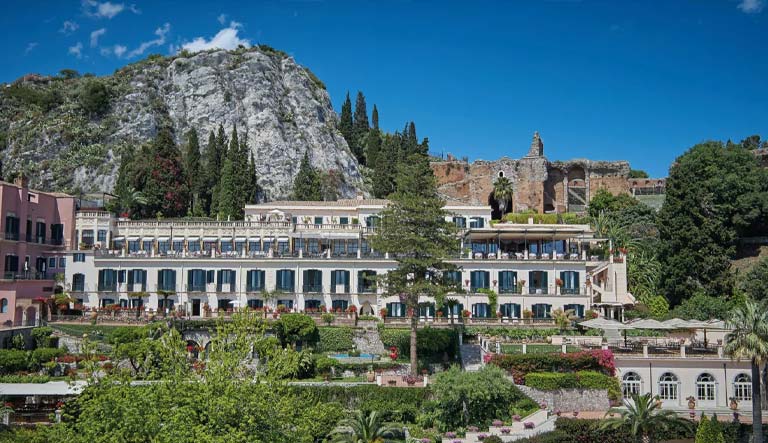
Most hotels in Taormina sit inside the old town. Grand Hotel Timeo sits just above it, next to the Greek Theatre, with open views toward Mount Etna and the coastline.
That positioning is not incidental. It is the whole point.
Clients staying inside the town are in it, the energy, the movement, the crowds. That works for some travelers. For others, Timeo creates just enough distance to experience Taormina without being pulled into it.
The access is what changes behavior. Guests step out, move through town on their own terms, and return without planning it. Taormina stops being a scheduled outing and becomes something they move through. That shift keeps the stay from flattening too early.
Timeo makes the middle of the day easy to manage.
Because the property sits above the fray, time does not need to be managed around escape. Mornings in town before the crowds arrive, midday back at the hotel, late afternoon out again. The day flows naturally.
Midday is where this matters most. In Taormina, that part of the day always returns to the hotel. At Timeo, the gardens, pool, and terrace absorb it naturally. The stay continues without interruption, and the rhythm holds.
Two additions are worth building into the stay early.
Villa Timeo introduces a private accommodation option nearby. Same access, same flow into town, with more space and separation. It works well for longer stays, small groups, or anyone looking for a quieter return at the end of the day. If privacy is the priority, this is the extension, not a shift to a different property.
The Dior Spa gives the afternoon a place to settle. Without it, that part of the day tends to drift. The spa pulls the day inward and gives it a second shape, morning outward, afternoon at the property, evening reset.
How many nights at Timeo depends on the itinerary.
For a standalone Taormina stay, three nights is the floor. Four allows the rhythm to develop without forcing it. Five works when the stay includes Villa Timeo or when the pace is intentionally slower.
As part of a broader Italy trip, two nights is enough when paired with Sant’Andrea.
The Shift to the Coast
This is where most Taormina itineraries stop short.
Clients have the town. The view. The Theatre. Evenings on the terrace.
It feels complete, and for a shorter stay, it can be.
For longer stays, that changes around day three. The town has done its job. The rhythm is set. Without a second layer, the days begin to repeat.
The move to the coast is what makes the stay work.
Mazzarò Bay sits directly below Taormina. The distance is short. The shift in pace is immediate.
In town, the day is built around movement. When to go out, when to return, how to work around the crowds. On the coast, that falls away.
The hesitation is usually the same.
Not wanting to move hotels.
Not having enough nights.
Questioning whether the coast changes enough to justify it.
It does.
It is not a disruption. It is a change in pace. Two parts of the same destination, experienced differently.
Two nights in town and two nights on the coast is a complete version of Taormina. The balance can shift, but the split remains.
Timing matters. The midpoint, or just after it, is where the shift works best.
Sant’Andrea and What Changes
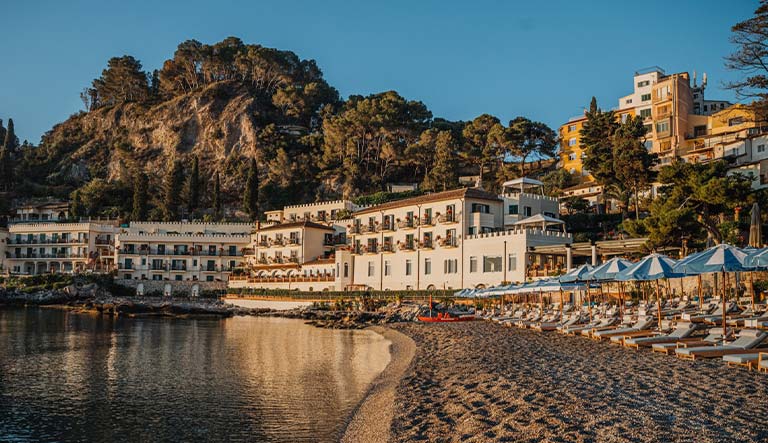
Villa Sant’Andrea sits directly on Mazzarò Bay, at the base of the hill below Taormina.
The setting is specific. A small, protected bay. Calm water. A private beach. The town still visible above, but no longer setting the pace.
Sant’Andrea does not replace Taormina. It completes it.
In town, the day is built in pieces. Where to go, what to see, when to move.
At Sant’Andrea, that changes. Once the day begins, it simply flows.
For clients coming off a sequence of cities, transfers, and structured days, this is where the trip slows in the right way.
The Beach Club
The Beach Club is not an amenity. It is the day.
Guests arrive in the morning and stay. Into the water, back to the cabana, into lunch, then back again. Nothing interrupts it. The setting stays constant, and the day moves through it without breaking.
By this point in the trip, that continuity matters. It is where the pace settles and the need to plan falls away.
Boat Access
Boat access directly from the property changes how the coastline is experienced.
Without it, time on the water becomes a separate plan. A transfer to a marina. A scheduled departure. A break in the day.
Here, none of that applies. Guests leave from where they are and return to the same place.
Isola Bella is often seen from above. From the viewpoints in Taormina, it is part of the landscape. Reaching it directly from the property changes the experience, and it is often one of the moments that stays with clients after the trip.
Who It Works For
Sant’Andrea fits a wider range of travelers.
Couples and honeymooners move into it easily.
Clients coming off longer itineraries use it to slow the trip down.
Families balance time between the beach and the water.
It also works for return travelers who experienced Taormina only from the town and want the destination to feel different the second time.
What it does not do on its own is replace the town for clients who came specifically for its history, energy, and cultural depth. In those cases, it remains the second half, not the starting point.
The sequence follows the experience, not the map.
The Takeaway
Taormina sells itself easily.
The most common mistake is how the stay is put together.
A single-property stay works for a few nights. Beyond that, it starts to flatten.
Taormina needs two parts.
Four nights works best as two and two.
Five nights can lean either way.
Six nights gives both sides space to settle.
The sequence is always the same. Town first. Coast second.
The town gives clients culture and access. The coast gives them the space to slow down. Reversing it works against the experience.
What matters is not adding more. It is placing each part at the right time.
At Timeo, the stay benefits from shape.
An early Theatre visit.
One Etna experience.
One food-driven moment.At Sant’Andrea, that rhythm falls away.
Time mostly spent on the water.
A boat day.
One evening back in town if it fits.
Together, they create something a single stay cannot.
Taormina does not need more nights. It needs a second half.
That is how UJV builds Taormina.